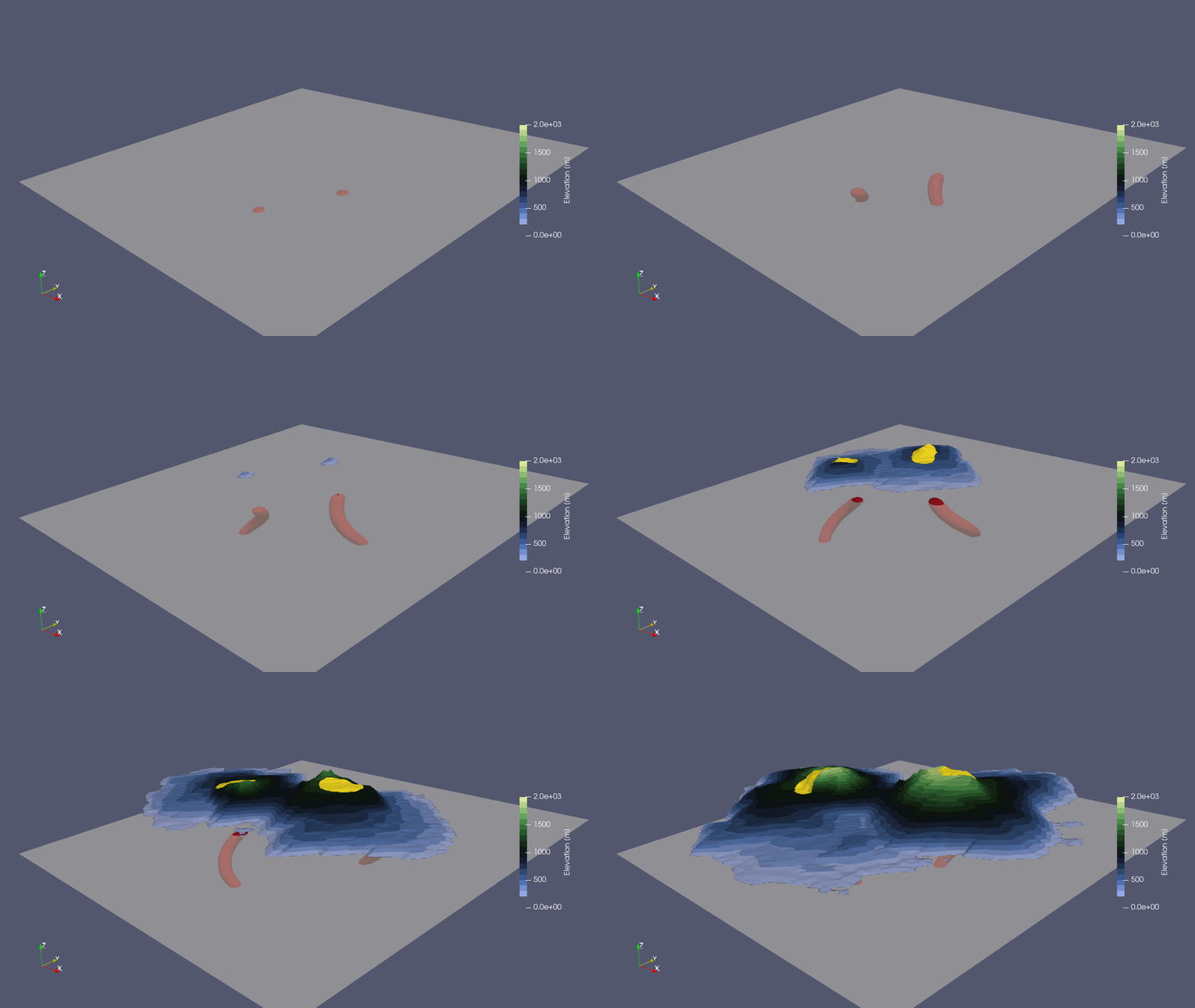
Linking Melt Extraction to Edifice Growth
An ASPECT geodynamic model coupled to a LandLab surface evolution model. The ASPECT model prescribes two sources of melt which rotate in a circle, forming plumes (red contours) which rise upwards due to buoyancy forces. The melt reaches a depth of extraction (transparent white plane), where it is removed from the ASPECT model. The volume of melt extracted from ASPECT is computed and is sent to the Landlab model where it is routed across the surface using a Bingham visco-plastic rheology, building a volcano. The yellow surface imposed on the Landlab topography shows where lava is being vented onto the surface.

2D Subduction with Parameterized Devolatilization
I developed time-dependent 2D subduction models which simulated two-phase reactive fluid transport to investigate how fluid–solid coupling influence subduction dynamics and fluid pathways. The background colourmap shows the viscosity, while the blues/whites superimposed shows the distribution of free water. The green contours show where water in bound within the solid matrix. Publication in prep.
Landlab-ASPECT Coupled Model
Animation showing an initial implementation of the landscape evolution software LandLab coupled to ASPECT. Both the LandLab mesh (white) and the ASPECT mesh (cyan) are unstructured.
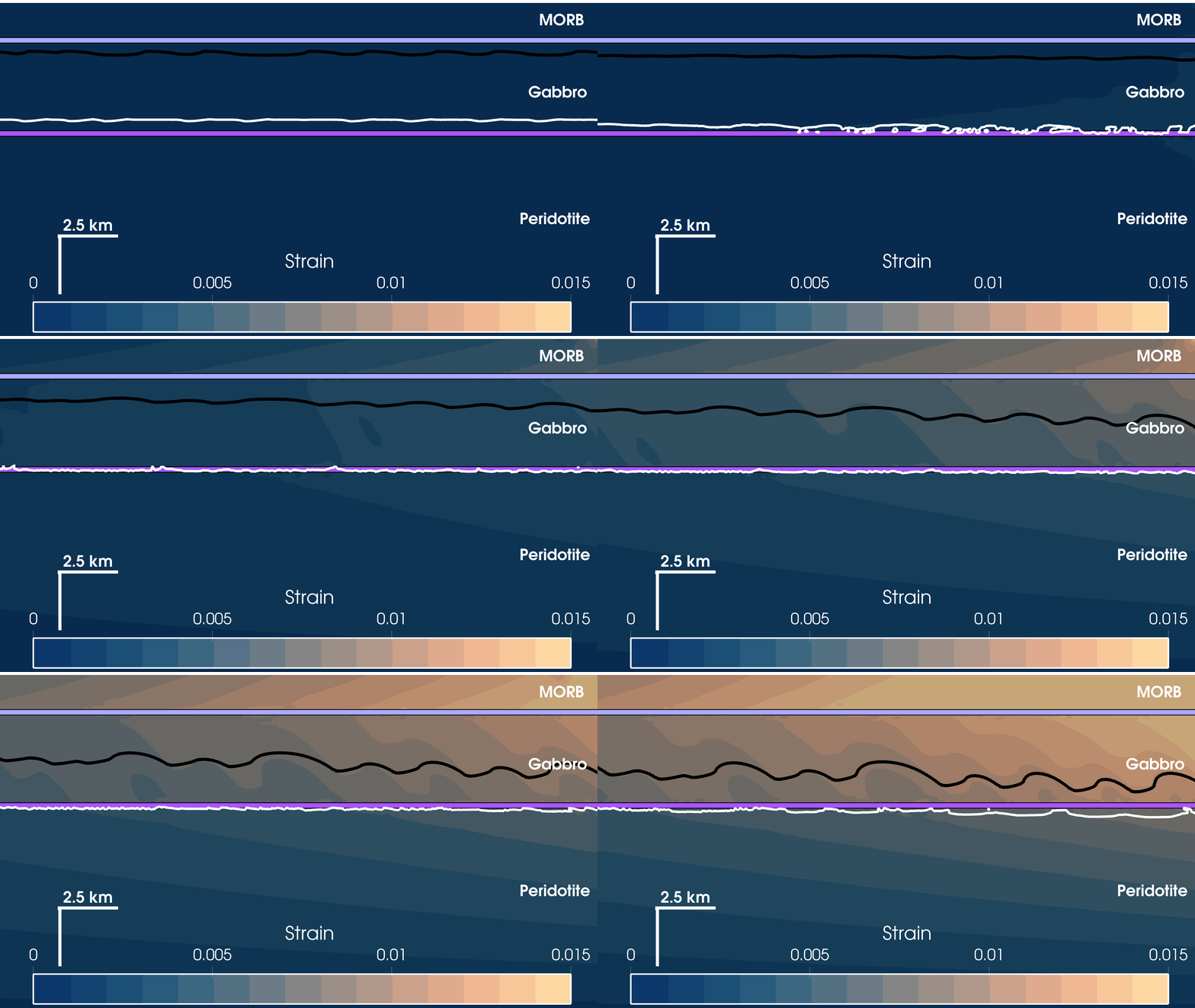
Outer-Rise Hydration in a Poro-elastic Crust
Animation showing how the volume of pore fluid (1 %, black contour, 0.5 %, white contour) increases due to bending of the oceanic lithosphere in the Outer-Rise region of Central America. The model was developed using the finite element code PyLith.
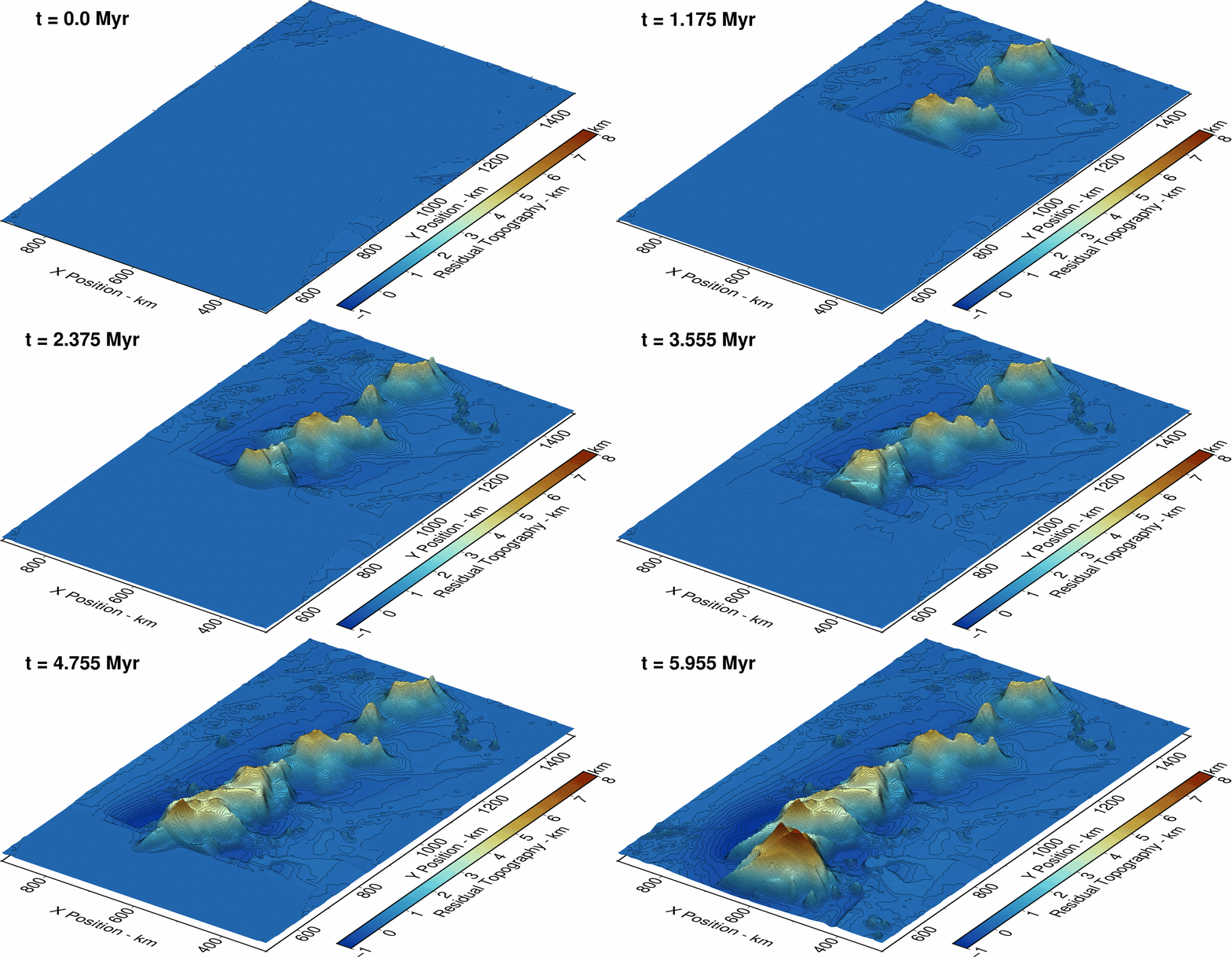
Growth of the Hawaiian Islands
Animation showing the growth of the Hawaiian Islands over time used to model the flexural response of the Pacific plate.

3D Models of Subduction at the Hikurangi Margin
I developed instantaneous models of subduction at the Hikurangi margin to investigate the effects of plate interface rheology and hydration on subducting dynamics and mantle anisotropy.